
 EN
How to deal with poor adhesion, leaks, and low production pass rate of enamel inner tanks for water heaters?
If problems such as poor adhesion of the enamel layer, water leakage, or low production qualification rate occur in the inner tank of an enamel water heater, it will have a serious impact on enamel water heater manufacturers, restricting production capacity improvement and brand development.
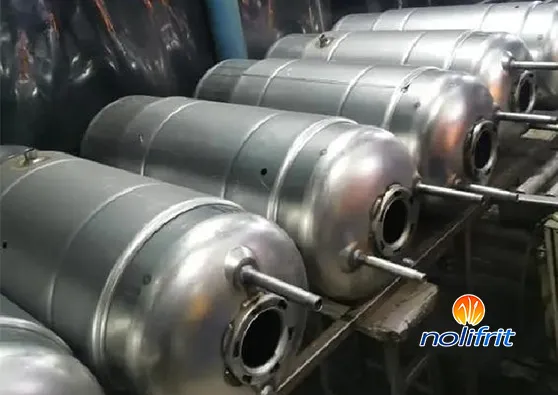
Question 1: Poor adhesion and easy to peel of the enamel layer, troublesome repairs reduce the production efficiency. What to do?
Many enamelware manufacturers face the problem of using enamel powder with poor adhesion or deviations in process control, resulting in insufficient adhesion of the inner enamel layer and frequent localized enamel peeling. Enamel peeling not only requires re-enamelting and repair, consuming a lot of manpower, material resources, and time cost, but also directly affects production progress, causing reduced output and decreased profits, leaving manufacturers in dire straits.
Question 2: What if the inner tank has insufficient corrosion resistance and leaks, causing complaints that damage the brand's reputation?
Inner tank leaks are a major source of after-sales complaints about water heaters. Inadequate corrosion resistance of the enamel layer easily leads to pitting corrosion and leaks. National standards mandate an 8-year warranty for water heater inner tanks, but some manufacturers fail to meet this standard due to substandard enamel powder quality, resulting in persistently high complaint rates. Frequent leaks not only increase after-sales costs but also severely damage the brand's image among consumers, hindering its long-term development.
Question 3: The powdery coating on the inner tank of enamel water heaters is difficult to handle, resulting in low pass rates and low production efficiency, which weakens competitiveness. What can be done?
Enamel liner powder has poor fluidity and is difficult to enamel evenly, making it prone to uneven coating thickness during spraying. Furthermore, the firing process can lead to problems such as scorching and underfiring, significantly reducing the first-pass yield. This low production efficiency not only increases unit product costs but also puts companies at a disadvantage in the fierce market competition.
High-quality enamel liner powder can solve these three major problems!
The enamel liner powder is developed and produced in strict accordance with national standards, and our own professional laboratory safeguards product quality. Key indicators such as adhesion performance testing, acid and alkali corrosion resistance testing, and boiling water weight loss testing are monitored in real time to ensure the stable and reliable quality of every batch of enamel powder from the source.
Using high-quality enamel inner liner powder can effectively improve the adhesion of the enamel layer and eliminate the risk of enamel peeling; it can also enhance the corrosion resistance of the inner liner, easily meet national standard quality assurance requirements, and reduce the user complaint rate; at the same time, its excellent process adaptability can achieve uniform coating leveling, reduce firing defects, help manufacturers improve first-pass yield and production efficiency, and reduce costs and increase efficiency.
In addition, Nolifrit can provide supporting quality inspection reports, so that enamel manufacturers can purchase with confidence and produce with peace of mind. With its solid quality and professional service, Nolifrit helps enamel water heater manufacturers break through development bottlenecks and build a solid brand competitiveness!