
 EN
Enamel RTU powder helps enamel manufacturers optimize hidden costs
Optimizing hidden costs goes beyond visible savings. Most enamel manufacturers focus solely on explicit expenditures like equipment procurement and labor wages when calculating costs, overlooking the hidden losses embedded throughout the entire production process. While these losses may seem insignificant individually, their long-term accumulation significantly erodes profit margins, becoming an invisible killer that constrains corporate profitability.
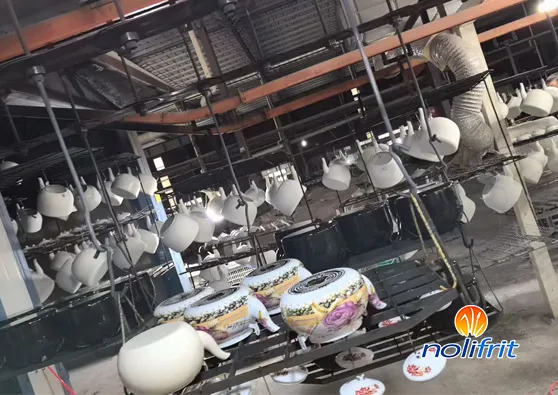
In the past, certain enamel glazes suffered from crude production processes and insufficient formulation stability, significant variations in particle size and composition between batches leading to enamel products exhibiting uneven coloration, pinholes, and de-glazing after firing. Rework rates commonly reached 5%-8%, not only wasting raw materials but also tying up production resources such as kilns and labor, delaying delivery schedules, and potentially triggering customer claims. In inventory management, enamel frits or universal ready-to-use powders require bulk procurement and stockpiling. Small and medium-sized manufacturers face unstable order volumes, making them prone to inventory buildup that occupying a large amount of working capital. Additionally, glaze materials have expiration dates; prolonged storage leads to performance degradation, ultimately requiring disposal.
In addition, some enamel glazes have poor adaptability. When faced with different substrates and varying process requirements, manufacturers must repeatedly fine-tune formulations and adjust process parameters. The raw material waste, energy consumption, and time costs incurred during this trial-and-error process also become a significant hidden expense that cannot be ignored.
Enamel ready-to-use powder, through full-process standardized control and customized services, helps manufacturers build a solid cost-control barrier. In terms of batch consistency, every step—from raw material selection and precise formula proportioning to uniform grinding—is managed through parameterized control, strictly keeping the product rework rate below 1%. Taking a mid-sized cookware manufacturer as an example, after cooperation, rework losses caused by glaze-related issues were reduced by 80%, saving nearly RMB 20,000 per month in substrate and glaze costs. In inventory management, the traditional industry practice of large minimum order quantities is broken by introducing small-batch customized services with a minimum order of 50 kg. Manufacturers can flexibly purchase based on actual order volume, eliminating the need for large inventory reserves. This effectively improves cash flow, reduces capital tie-up and expiration losses, and is especially well suited to small and medium-sized manufacturers facing fragmented orders and tight working capital. At the process adaptation level, Nolifrit is equipped with a dedicated technical team that optimizes enamel RTU powder formulations in advance and provides tailored process solutions based on each manufacturer’s substrate type, glazing method, and kiln parameters. This helps manufacturers bypass repeated trial-and-error stages, shortening the trial cycle by an average of 70% and reducing trial costs by over 70%. As a result, manufacturers avoid additional expenses for process adaptation, achieving true all-dimensional cost reduction—where explicit costs are visibly reduced and hidden costs are effectively controlled.