
 EN
Core Control Points of the Glazing Process for Enamel Liners of Water Heaters
For the glazing process of enamel liners of water heaters, enamel manufacturers must strictly control the following 6 key links to ensure that the final enamel layer meets the application requirements.
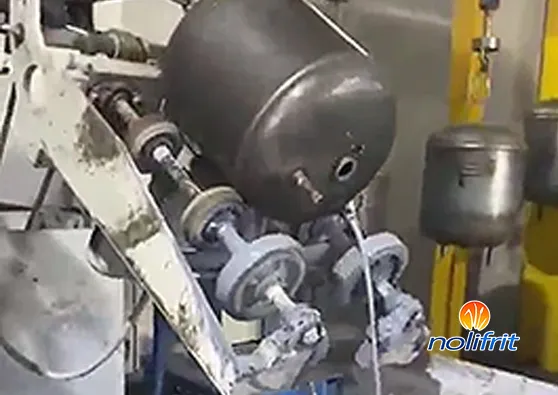
1.Control of Water-Powder Ratio
Add 38%–40% of water into a clean container first, then put in enamel powder (water heater liner powder) in proportion. After thorough mixing, let it stand for 30–40 minutes and stir evenly during this period to ensure good dispersibility of the glaze slip. At this time, the initial adsorption capacity of the glaze slip should be controlled at 23–26 grams to reserve room for subsequent aging adjustment.
2.Sieving and Aging Treatment
The mixed glaze slip must be filtered through a 40-mesh screen to remove impurities and undispersed lumps, so as to avoid affecting the flatness of the coating. After filtration, transfer it to a clean container for 3–6 hours of aging. Stir evenly again after aging and adjust the adsorption capacity of the glaze slip to 18–22 grams before use. It should be noted that the adsorption capacity of enamel powder will be relatively low in low-temperature winter conditions, so the ratio needs to be fine-tuned in advance.
3.Adjustment of Glaze Slip Bulk Density
The bulk density of the glaze slip directly affects the coating thickness and adhesion effect, and must be strictly controlled within the range of 175–185 g/100ml. Excessively high bulk density tends to cause the coating to be too thick and crack, while excessively low bulk density may lead to incomplete coverage.
4.Control of Enamel Coating Thickness
After high-temperature firing, the final thickness of the enamel coating should reach 150–500 μm. Insufficient thickness will reduce corrosion resistance; excessive thickness may cause cracks and peeling during firing or use due to the difference in thermal expansion and contraction coefficients.
5.Prevention of Excessively Thick Coating at the Liner Bottom
Due to gravity, glaze slip is prone to accumulate at the bottom of the liner, resulting in locally excessive coating thickness and subsequent pinhole defects during firing. The retention amount of glaze slip at the bottom can be controlled by adjusting the tilt angle of the rotary enameling machine. Ideally, the glaze slip should only cover 1/3 of the bottom area.
6.Strict Implementation of Firing Curve
The firing process is the key to enamel coating formation, and the firing temperature should be stably maintained at 840–860℃. Specifically, when the temperature rises above 800℃, the melting and firing time should be kept for 8–12 minutes; after entering the high-temperature firing zone above 840℃, continue melting and firing for 5–8 minutes to ensure that the enamel powder is fully melted and leveled, and forms a firm bond with the metal liner.