
 EN
Practical Operation Guide for Enamel RTU Powder: Supporting Stable Quality in Enamel Production
The effectiveness of enamel RTU powder relies not only on the quality of the product itself but is also closely related to scientific operation methods. Nolifrit adheres to the service philosophy of "not only selling products but also providing solutions." We have compiled a scientific usage guide for enamel RTU powder to assist enamel manufacturers in avoiding operational pitfalls and ensuring stable product quality.
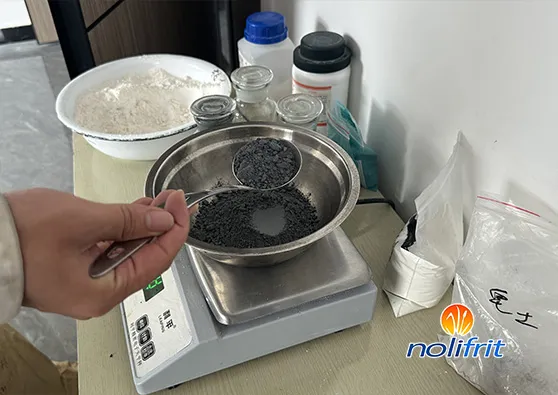
I. Water Mixing Ratio Technique
The enamel RTU powder is designed with a scientific formulation ratio. When mixing with water, it is essential to follow the principle of "water first, powder later" to prevent the dry powder from clumping. The specific mixing ratio should be adjusted according to different product series. For RTU powder used in daily kitchenware, a water-to-powder ratio of 1:0.4–0.45 is recommended, while for industrial acid-resistant RTU powder, a ratio of 1:0.35–0.4 is advised. Use a low-speed mixer for stirring, and control the stirring time to 10–15 minutes to ensure a smooth, particle-free glaze slurry.
II. Key Points of Glaze Application Process
The glaze application method can be selected based on the product type, such as spraying, dipping, or curtain coating. For spraying, control the spray gun pressure at 0.3–0.4 MPa, maintain a distance of 20–30 cm from the product surface, and avoid overly thick or thin glaze layers. For dipping, control the immersion time to 5–10 seconds, and after removal, allow excess glaze slurry to drain slowly. For curtain coating, ensure a uniform flow rate of the glaze slurry to prevent localized accumulation. The recommended glaze layer thickness is 0.1–0.5 mm. Excessive thickness may cause post-firing blistering or enamel peeling, while insufficient thickness may result in poor coverage.
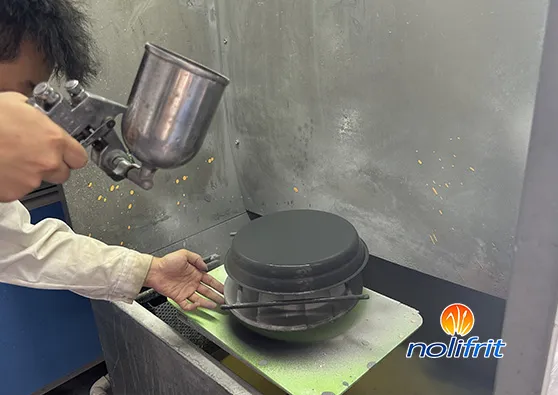
III. Control of Firing Curve
Firing temperature and time are critical factors determining enamel quality. For daily kitchenware products, a firing temperature of 800–850℃and a holding time of 10–15 minutes are recommended. For industrial equipment products, a firing temperature of 850–900℃ and a holding time of 15–20 minutes are suggested. The heating process should be gradual, avoiding sudden temperature fluctuations to prevent product cracking. After firing, allow the product to cool naturally rather than forcing rapid cooling.
IV. Key Quality Control Measures
After the glaze slurry is prepared, it is recommended to perform screening using a 40–60 mesh sieve to filter out impurities. Before glaze application, ensure the product substrate surface is clean, free of oil, and rust. After firing, promptly inspect the product’s appearance. If issues such as pinholes or bubbles arise, refer to Nolifrit’s technical team’s "Troubleshooting Manual for Common Problems" to adjust process parameters.
By following the above operational guidelines, the performance advantages of enamel RTU powder can be fully utilized, helping enamel manufacturers steadily improve product qualification rates and reduce production losses.