
 EN
What Type of Enamel Should Be Used for Stainless Steel?
Compared with conventional cold-rolled steel enameling, stainless steel enameling is considerably more challenging. The primary reason lies in the differences in substrate properties, which are also the main cause of common defects such as enamel chipping, poor adhesion, and enamel peeling encountered by many manufacturers. Stainless steel differs significantly from cold-rolled steel in three critical aspects: softening point, chemical stability, and coefficient of thermal expansion. As a result, conventional enamels designed for carbon steel are not suitable for stainless steel substrates and often lead to inadequate adhesion, poor firing compatibility, and unstable enamel coatings.
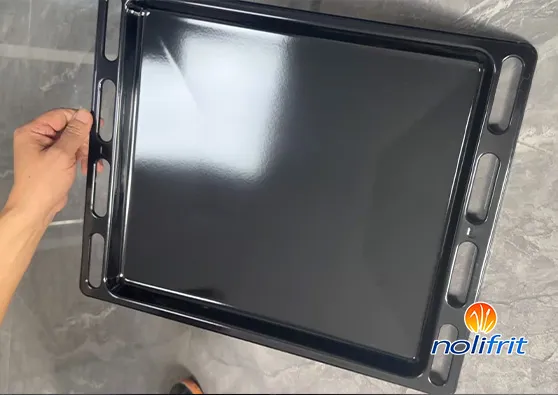
Stainless steel possesses high chemical stability and a more inert surface, making it difficult for ordinary enamels to form an effective bonding layer during firing. In addition, its coefficient of thermal expansion and softening temperature differ from those of carbon steel. When conventional enamels are applied, excessive internal stress develops during firing, which can result in cracking or delamination of the enamel layer and significantly reduce production yield. Therefore, stainless steel enameling requires specially formulated enamels specifically designed for stainless steel applications rather than standard enamels intended for carbon steel.
A dedicated enamel for stainless steel must be precisely engineered to match the thermal expansion characteristics of the substrate, optimize the frit formulation to minimize internal firing stress, and enhance interfacial bonding to achieve strong adhesion on the inert stainless steel surface. Nolifrit's RTU7321 Stainless Steel Ready-to-Use Enamel Powder is a highly compatible solution specifically developed to overcome adhesion challenges in stainless steel enameling. It offers a wide firing temperature window, produces a dense and uniform enamel coating with excellent adhesion, and is well suited for the mass production of various stainless steel enameled products.
For enamel manufacturers, replacing general-purpose enamels with stainless steel-specific formulations is the key to improving product quality, reducing production losses, and ensuring stable, large-scale manufacturing performance.